


Disclaimer: Academic purposes only
Theoretical Perspective
1. FUNCTIONALISM
>Functionalism, also called as structural functional theory, it sees society as a needs of individuals who make up that society.
1. it grew out of the writings of English philosopher and biologist Herbert Spencer who likened society to a human body. He argued that just as the various organs in the body work together to keep the entire system functioning and regulated, the various parts of society work together to keep the entire society functioning and regulated. this parts of society are social institution as the economy, political system, healthcare, education, media, and region.
2. Durkheim believe that earlier, more primitive societies were held together societies were held together because most people performed similar tasks and shared values, language, and symbols. They exchanged goods and services in similar ways, Modern societies were more complex. people served many different functions in society and their ability to carry out theirs. Durkheim's theory sees society as a complex system of interrelated parts, working together to maintain stability. According to this sociological view point, the parts of society are interdependent. This means each part influences the others. In a healthy society, all of these parts work together to produce a stable state called dynamic equilibrium.
3. Durkheim believe that individuals may make up society, but in order to study society, sociologists have to look beyond individuals to social facts. social facts are the laws, morals, values, religious belief, customs, fashions, rituals, and all of the cultural rule that govern social life. Each of these social facts serves one or more functions within society.
4. Another noted structural functionalism, Robert Merton, pointed out that social processes often have many functions, Manifest functions are the sequences of a social process that are sought of a social process social processes that have undesirable consequences for the operation of society are called dysfunction.


2. CONFLICT THEORY
>Another theory with a macro-level view, called conflict theory, looks at society as a competition for limited resources.
1. Conflict theory sees society as being made up of individuals who must complete for social , political, and materials resources such as political power, leisure time, money housing, and entertainment. social structures and organizations such as religious groups, governments, and corporations reflect this competition in their inherent inequalities.
2. Some individuals and competitions are able to obtain and keep more resources than others. these "winners" use their power and influence to maintain their positions of power in society and to suppress the advancement of other individuals and groups.
3. Karl Marx is most closely identified with this theory. he focused on the economic conflict between different social classes. The German sociologist Max Weber agreed with Marx that the economic inequalities of the capitalist system were a source of widespread conflict. However, he disagreed that the conflict must lead to revolution and the collapse of capitalism.
4. He theorized that there was more than one cause for conflict: besides economics, inequalities could exist over political power and social status. The level of inequalities could also be different for different groups based on education, race, or gender. As long as these conflict remained separate, the system as a whole was not considered threatened. He also identified several factors that moderated people's reaction to inequality.
5. If the authority of the people in power was considered legitimate by those over whom they had power, then conflicts were less intense


3.SYMBOLIC INTERACTIONISM THEORY
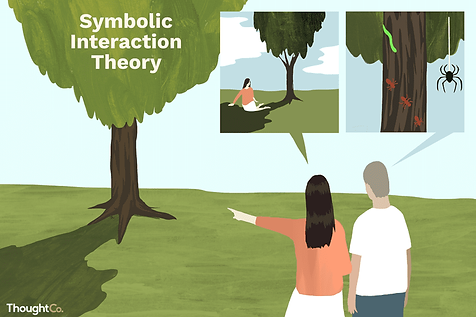
> Symbolic Interactionalism provides a theoretical perspective that helps scholars examine the relationship of individuals within their society. This perspective is centered on the notion that communication or the exchange of meaning through language and symbols-is how people make sense of their social worlds.
1. As pointed out by Herman and Reynolds, this viewpoint sees people as active in shaping their world, rather than as entities who are acted upon by society. This approach looks at society and people from a micro-level perspective.
2. George Herbert Mead is considered one of the founders of symbolic interactionism, though he never published his work on it was up to his student Herbert Blumer to interpret Mead's work and popularize the theory. He coined the term "symbolic interactionism" and identified its three basic premises.
3. Humans act toward things on the basis of the meanings they ascribe to those things. The meaning of such things is derived from, or arises out of, that one has with others and the society
3. These meanings are handled in, and modified through, an interpretative process used by the person in dealing with the things he/she encounters.

4. EXCHANGE THEORY
> It has economic, anthropological, psychological and sociological underpinnings. Its basic orientation is that life is a continual occurrence of rewards and costs exchange
1. Economically, people exchange money, goods and services, looking towards some profit or breaking even in the exchange.
2.Anthropologically, psychologically, or sociologically, and factors and also involved. Labor, gift, money, affection and Ideas are simply or totally offered for something in return.
3. Its basic assumptions are, most human stratification are derived from the actions of other humans, new associations are started because they are expected to be rewarding and old associations because they are rewarding.
4. When we received rewards or benefits from others, we are obliged to reciprocate by supplying benefits to them in return. In general, giving is more blessed than receiving because social credit is preferable to social indebtedness.


1. HIERARCHY THEORY
> Hierarchy theory was developed in an attempt to understand how group-based social hierarchy is formed and maintained. Unlike most other theories of prejudice, stereotypes, and discrimination in social psychology.
1. Including cultural ideologies and policies, institutional practices, relations of individuals to others inside and outside their groups, the psychological predispositions of individual of individuals, and the interaction between the evolved psychologies of men and women.
2. According to this theory, group-based social hierarchy is produced by the net effect of discrimination across multiple levels, institutions, individuals, and collaboration intergroup processes.
3. Social hierarchies are omnipresent in the lives of many species. The ability to successfully navigate complex social environments with consideration of the native rank of conspecifics is an essential skills not only for humans, but also for numerous other social beings.
4.Social hierarchies been identified across a broad range of organism, from simpler model systems such as insects, to nonhuman and human primates. Greater complexity can be found in the social hierarchies of mammals, such as rats and primates, with increased research demonstrating the impact of relative social status on communication, reproductive behavior, and access to resources.


For more information just click the link below
#payagnimacapil